
Grappling with the Avant-garde: Revisiting Classical Music’s Most Experimental and Divisive Period - Part 1: "Getting Oriented"
What was the Avant-Garde? (And does it bite?)
“Why even bother?” I hear you say.
“Why even bother grappling with the avant-garde? As a movement it’s dead and gone. And it wasn’t very pleasant music to listen to anyway. All that scratching about, no harmony, no tunes…”
I hear you. I feel the same way about a lot if it. And yes, as a “movement” the “avant-garde” - at least in its 20th century incarnation, its most powerful expression - is definitely over with, although its impulses linger.
But…
I still listen to a lot of it. And I still think about it, especially when I hear new classical music, or listen to the work of certain more experimental popular artists, like David Sylvian, Ryuichi Sakamoto, Brian Eno, Robert Fripp. Even David Bowie had an avant-garde streak. And those are just the names you might have heard of.
They’re all thinking about the avant-garde. And many are still listening to it.
So maybe we should too…
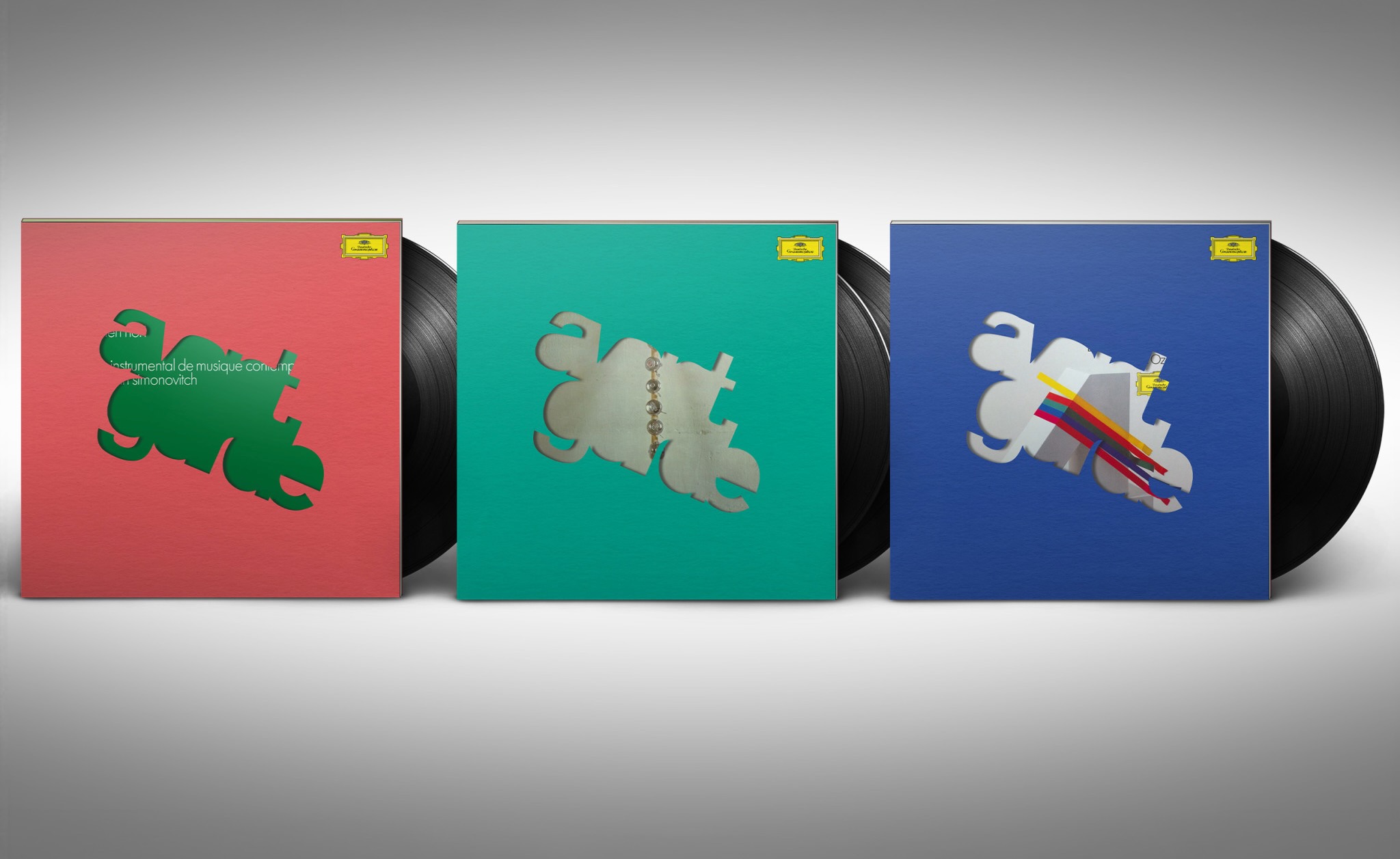
There are still discoveries to be made, as these three newly remastered Avant-garde records from the DG series of the same name prove.
Not only new discoveries, but maybe even a new love. One of these records shoots into my list of favorites of all the EBS remastered DG vinyl reissues we've had so far.
But before I get into those new reissues, there's a lot of fascinating scene-setting, history, ideas to explore. Plus some pretty amazing music. Exhilarating, infuriating, weird, beautiful, ugly - but always COMPELLING music. (And some of it is in movies, as I will discuss in Part 2).
So read on…
What’s All this “Avant-garde” About?
To prepare myself for writing the reviews of DG’s three vinyl reissues from its iconic Avant-garde series of the late 1960s and early 70s, I have been immersing myself in a wide range of music that is often lumped together under this general term: the avant-garde.
Roughly speaking, this is a period, and movement, of uncompromising and challenging modernism in classical music that began in earnest after WWII and continued in its fullest flowering up until the end of the 20th century.
Strictly speaking there is a difference between what is considered “avant-garde” and what is considered “modernist”. This distinction has kept musicologists and philosophers busy for decades. The best way to boil it down is to say that avant-garde music is more self-consciously revolutionary, more likely to be preoccupied with tearing down whatever formal, sonic or procedural norms it butts its head against. By that measure, the music of such early 20th century revolutionaries as Schoenberg, Webern, Stravinsky, Debussy would be considered avant-garde for their times. However, once a composer like Stravinsky adopts neo-classicism as his compositional mode he can no longer be considered “avant-garde”, even though he is still indisputably a modernist. Even when, in his final years, he turns to serialism, that is still not “avant-garde” because by that time serialism had been around and practiced for decades - and Stravinsky’s version of it was less confrontational.
A clutch of prominent post-WWII modernists like György Ligeti, Witold Lutoslawski, Milton Babbitt, Luciano Berio and Elliott Carter, while having their roots in the avant-garde, are eventually considered to not be fully paid up members of the avant-garde movement. That honour is reserved for the likes of John Cage and Harry Partch, who remained provocateurs to their dying days. John Cage’s 4’33” from 1952 is still the standard bearer for the avant-garde. The performer walks on stage, sits down as if to play, and then does nothing for 4 minutes and 33 seconds. The resulting “music” is the piece.
Upon hearing this work, Stravinsky quipped: “I only hope his silences will become longer.”
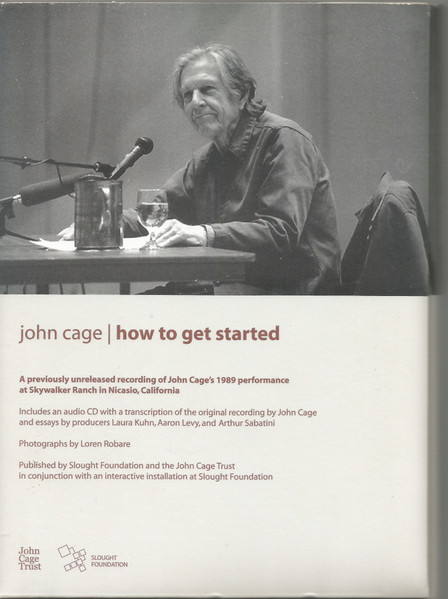 John Cage recording "How to Get Started at Skywalker Ranch - this is the cover of the limited edition CD release.
I actually met John Cage during a sound design conference at George Lucas’s Skywalker Ranch in 1989. (I was there because of my radio drama work for NPR which would sometimes incorporate more experimental sound design elements). With a twinkle in his eye, at the age of 77 Cage had lost none of his provocateur spirit and his performance of a work specially created for the occasion, “How to Get Started”, in which he interacted with constantly evolving “tape loops” of his own voice - all performed live - was completely avant-garde in conception and execution.
It was also mesmerizing.
The idea of an avant-garde movement per se really solidified in the late 1940s/50s. It’s no coincidence that this coincided with a widespread adoption amongst younger composers of Schoenberg’s serial/dodecaphonic/12-tone method of composition, seen as the necessary antidote to the predominant German musical hegemony of the previous several hundred years that was being roundly rejected in the wake of two world wars. As Pierre Boulez, one of the most radical and vocal of the Young Turks, once categorically stated:
“Any musician who has not experienced - I do not say understood, but truly experienced - the necessity of dodecaphonic music is USELESS. For his whole work is irrelevant to the needs of his epoch.”
Now tell us how you truly feel, Pierre...!!!
The epitome of this new modernist movement became the so-called Darmstadt School, named after a series of summer gatherings for composers, performers, theorists that began in the early 1950s. Leading lights of the Darmstadt School included Pierre Boulez, Luigi Nono, and Karlheinz Stockhausen.
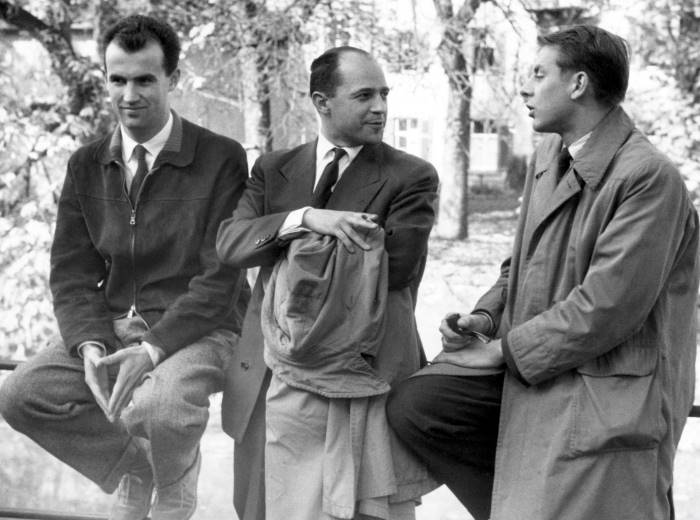 (from l. to r.) Luigi Nono, Pierre Boulez and Karlheinz Stockhausen at Darmstadt in 1957
The rise of the avant-garde also coincided with important advances in technology, making new modes of music possible. Specifically there was the arrival of reel-to-reel tape as a medium capable of recording sound with unprecedented fidelity, and of being edited, then played back either on its own or in conjunction with other instruments; and the arrival of new electronic sound generating equipment. Government funded radio stations like WDR Cologne in Germany quickly became centers for musical experimentation. Electronic music, whose sonic profile was unlike anything else in the classical canon because of its intrinsically non-acoustic, abstract nature, often more redolent of “noise” than “music”, became a calling card of the avant-garde and other modernists.
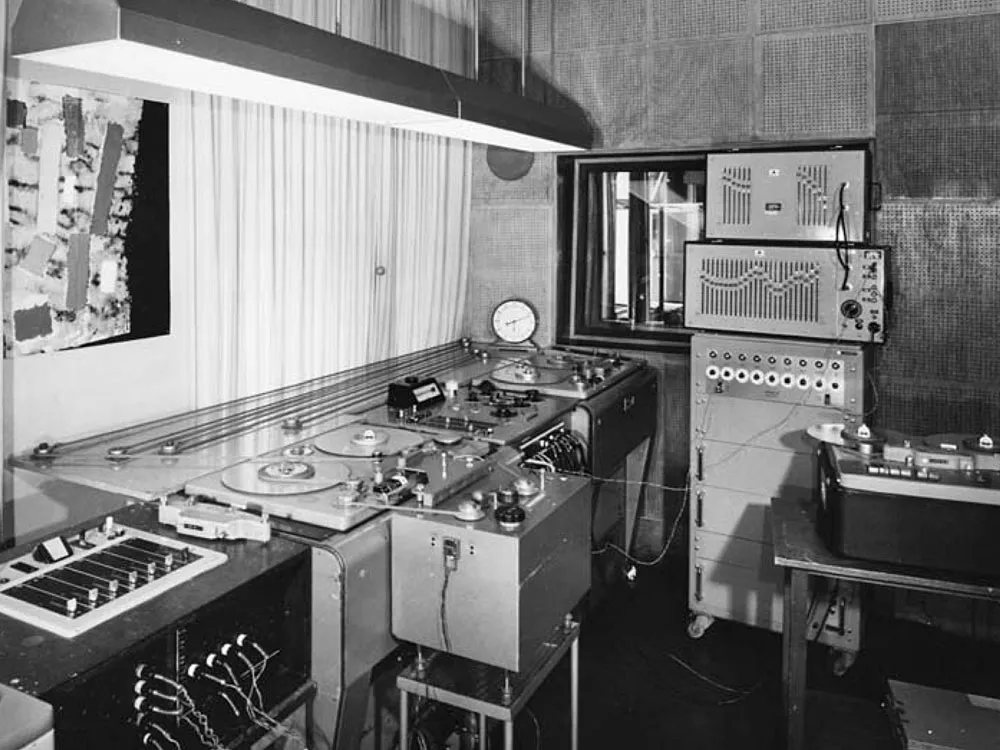 WDR Studios in Cologne in 1966
In 1970 Pierre Boulez was asked by President Pompidou to found an institute for research in music. The result was IRCAM (Institut de recherche et coordination acoustique/musique; Institute for Research and Coordination in Acoustics/Music), which opened in 1977 in the Centre Pompidou, Paris’s new radical space for modern art. Here Boulez and many other leading lights of the avant-garde and modernism from across the globe continued their explorations of the intersections of sound, music and technology.
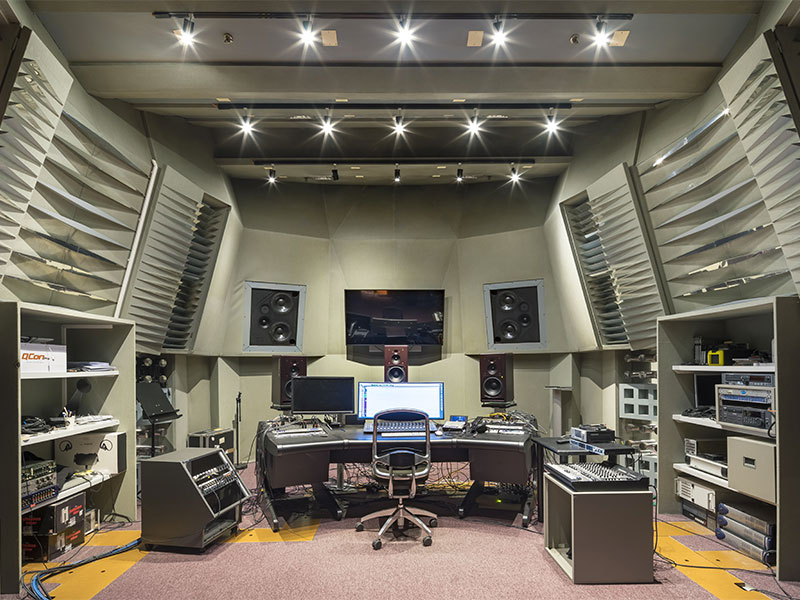 One of the studios at IRCAM
During the final decades of the 20th century, the avant-garde movement lost much of its more extremist steam, and it slowly morphed into the counter-surge of minimalism, then was subsumed into the return of a kind of modified and fluid tonality/atonality which tends to be the stylistic zone in which modern music resides today.
Nowadays, the weapons of the avant-garde - all that harmonic and sonic confrontation and dissonance, formal reinvention and reimagining of what constituted “music” itself - are merely part of the larger tool bag for modern composers who prize their music actually being heard (and paid for) over adherence to a perceived (but often illusory) intellectual and dogmatic purity.
The avant-garde - or rather the avant-garde impulse - is still very much with us. But it’s more likely to be found minding its manners at a fundraising event for new music programming at your local Symphony than detonating its cultural and aesthetic bomb clusters on a live radio broadcast. (Sometimes I cannot believe the stuff I was able to hear over BBC Radio 3 on a regular basis when I was growing up; in those days the important mission of public broadcasting remained intact).
Today the kind of avant-garde procedures developed in its heyday are more a style and approach to be sampled and/or referenced than fully adopted - that is, if you want to find a paying audience for your music. We have arrived at a point predicted by Stravinsky:
“Conformism is so hot on the heels of the mass-produced avant-garde that the 'ins' and the 'outs' change places with the speed of Mach 3”.
Considering the Avant-garde
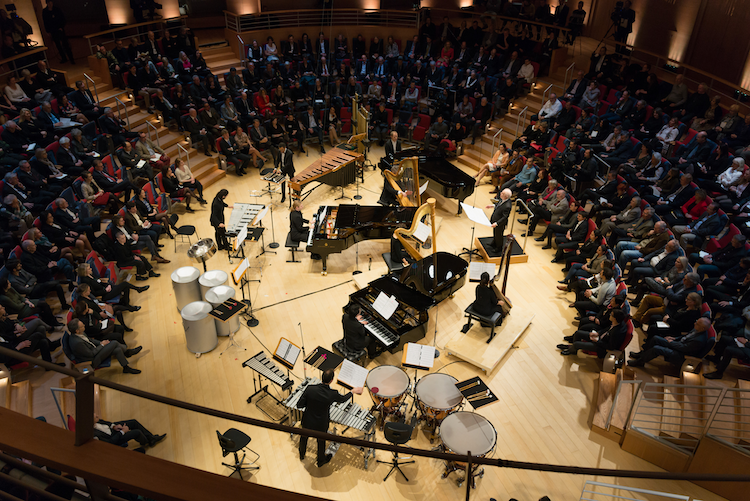 Boulez's Sur Incises in performance at the Pierre Boulez Saal at the Barenboim-Said Akademie in Berlin (Photo by Peter Adamik).
As I began preparing for these articles, I rapidly realized that to write about this music in a manner that both did it justice but was also easy and accessible was going to be as challenging as it often is to actually listen to the music itself. And it’s one thing to listen to this music as a seasoned classical lover and collector; it’s quite another if you are at or near the beginning of your classical explorations. This is music that can be very intimidating on every level, from what it actually is and its sound, to its intellectual underpinnings.
But I will also observe that often it's listeners who are less familiar with the traditional Western classical canon who are most receptive to the experimentation of the avant-garde and modernists in general. Interesting.
Since my aim in all my writing is to cater to as wide a range of potential listeners as possible, from newbies to seasoned music lovers, and to make the ideas and history behind the music, and the music itself, accessible and intriguing, I felt I needed to approach my subject from a variety of different angles. In other words I really had to think about how I was going to tackle this one. I began to think maybe I needed to come at it more sideways than head on - at least until the reader was oriented to the subject.
All of this internal debate was leading to this basic question: what is the best way to illuminate the music of the avant-garde itself, and the cultural context which gave rise to it, while also keeping people open to actually exploring this music which they perceive as "ugly" or "difficult", but which can yield rewards (or at least insights) beyond what we normally expect from “regular” music?
Because Mozart this music ain't!
Interesting that a film director, of all people, expressed the challenge of appreciating avant-garde music perfectly:
I think that music is a very difficult art form in which to be avant-garde. When we sit down to listen to a piece of music, I think our implicit hope is that we're going to find it beautiful, or at least emotional, on some level.
— Steven Soderbergh
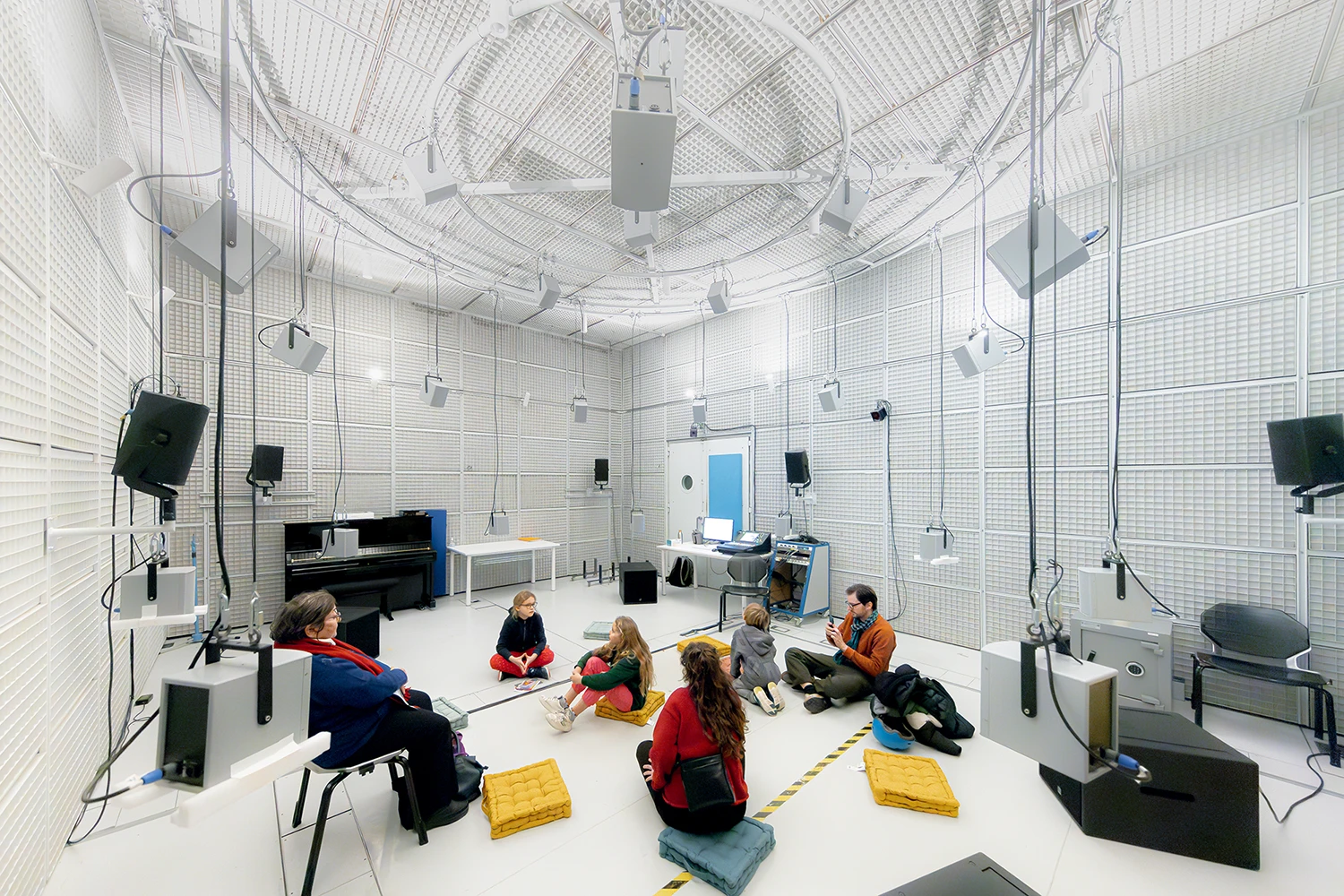 Children discovering Sound at IRCAM Studio 3. The great Russian film director Andrei Tarkovsky, often accused of being overly intellectual, obscure and "difficult" in his films, remarked that children are the ones who best appreciate and "get" his work - precisely because they come to it with no preconceived notions of what it "should" be.
A Revolution Preserved in Amber
Increasingly the music of the avant-garde during its fullest blossoming - music that once upon a time was considered the future of classical music, certainly all “serious” music - is now seen as something of an island viewed from the stern of a departing boat; or a brief way station along the route of the grand parade of classical music’s onward “progress”. The more radical impulses of all those 20th century avant-gardists and modernists have either slowly been subsumed and absorbed into less dogmatic music, or simply been abandoned completely.
Why is this?
The answer is simple.
People in general did not like, and still do not like, listening to this stuff.
Blunt, but essentially true.
Which means that little if any of this music I will be talking about is coming to a concert hall near you any time soon - not that it was performed much even back in those heady halcyon days of fervor for every new variety of modernism amongst the self-appointed taste makers and cultural intelligentsia.
But what that also means is that most of this music now ONLY exists in recordings. Which also means that these recordings represent so much more than just another version of a Beethoven symphony. They are historical artifacts. They are the most tangible historical record of an important but elusive period in music.
For good or ill, they are our collective musical memory.
And so, whatever you may think of this music, these records are important in a way that the latest, maybe 200th, recording of Beethoven’s 5th Symphony never will be.
They are, in many ways, the echoing roars of a now extinct species, preserved in amber like the DNA of those pesky Jurassic Park dinosaurs; ready to re-emerge at any time and cause havoc.
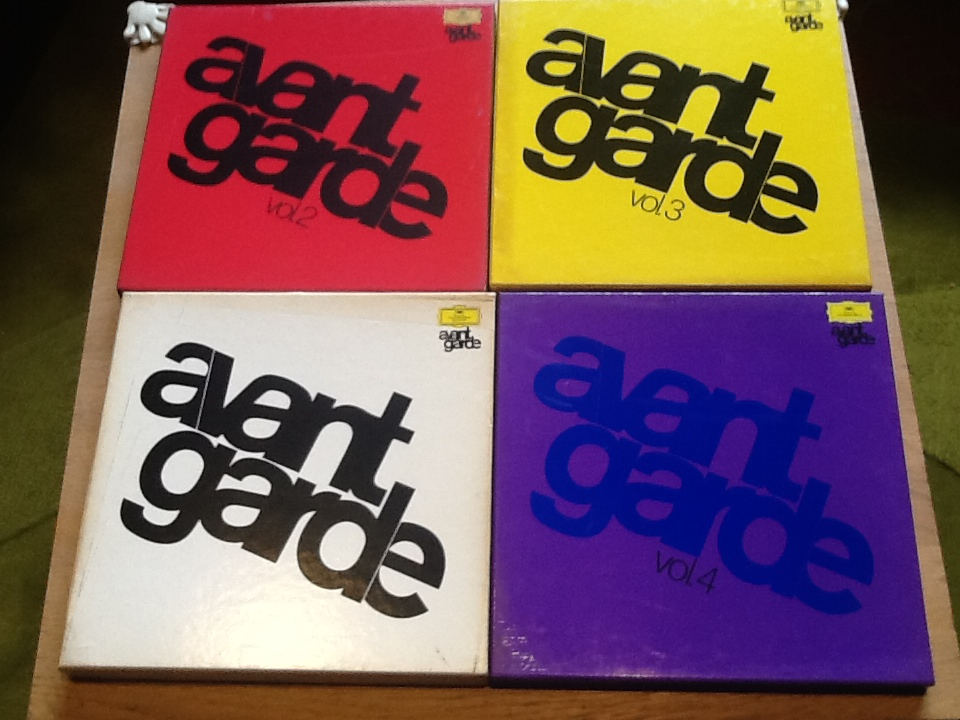 The original 4 multi-LP box sets of Deutsche Grammophon's Avant-garde series, released between 1969 and 1973
And as collectors and listeners of sound recordings, all of this should be of particular interest to us readers of Tracking Angle. Difficult this music may be, but I think it is very important to consider it closely, and to try and be open to what it’s saying, or trying to say. Because above all else this music demands we reassess the act of listening itself, and reconsider what music actually is (all of which I will be talking about in greater depth throughout these articles).
So my job then becomes to help you find ways into this music that do not get you bogged down in theory and the kind of pseudo-scientific academic writing that is the dead hand plaguing much self-styled “serious” music criticism and scholarship.
I want this to be fun. Fun to read, fun to write.
So I have chosen to approach the assignment in a variety of different ways, from different angles, to ease you into the mysterious world of the avant-garde via some more familiar paths that maybe you did not realize lead back to classical music’s greatest revolutionaries and their sonic conflagrations.
To provide you with a larger context - both musical and culturally - for why this music is the way it is.
To encourage you to listen beyond the surface of the music - which I will admit can be difficult with this stuff.
By the time we arrive at the three records under review you may still have mixed feelings about the music they contain, but I hope you will know why you have those mixed feelings.
But you may also feel more open to listening to it, even accepting it, or at least giving it a try - and if you do, you may find that same listening and pondering in turn leads you down some pretty interesting avenues of discovery. Indeed, you may find yourself re-evaluating previously held opinions and beliefs in relation not just to the avant-garde, but all music.
That, after all, was one of the principal purposes of the avant-garde - for listeners as much as composers and performers: to make everyone question everything.
Oh and yes, there’s going to be a substantial discography revealing itself along the way. Open up your Discogs and buckle up.
It’s going to be a bumpy ride.
Down the rabbit hole we go… Wonderland awaits.
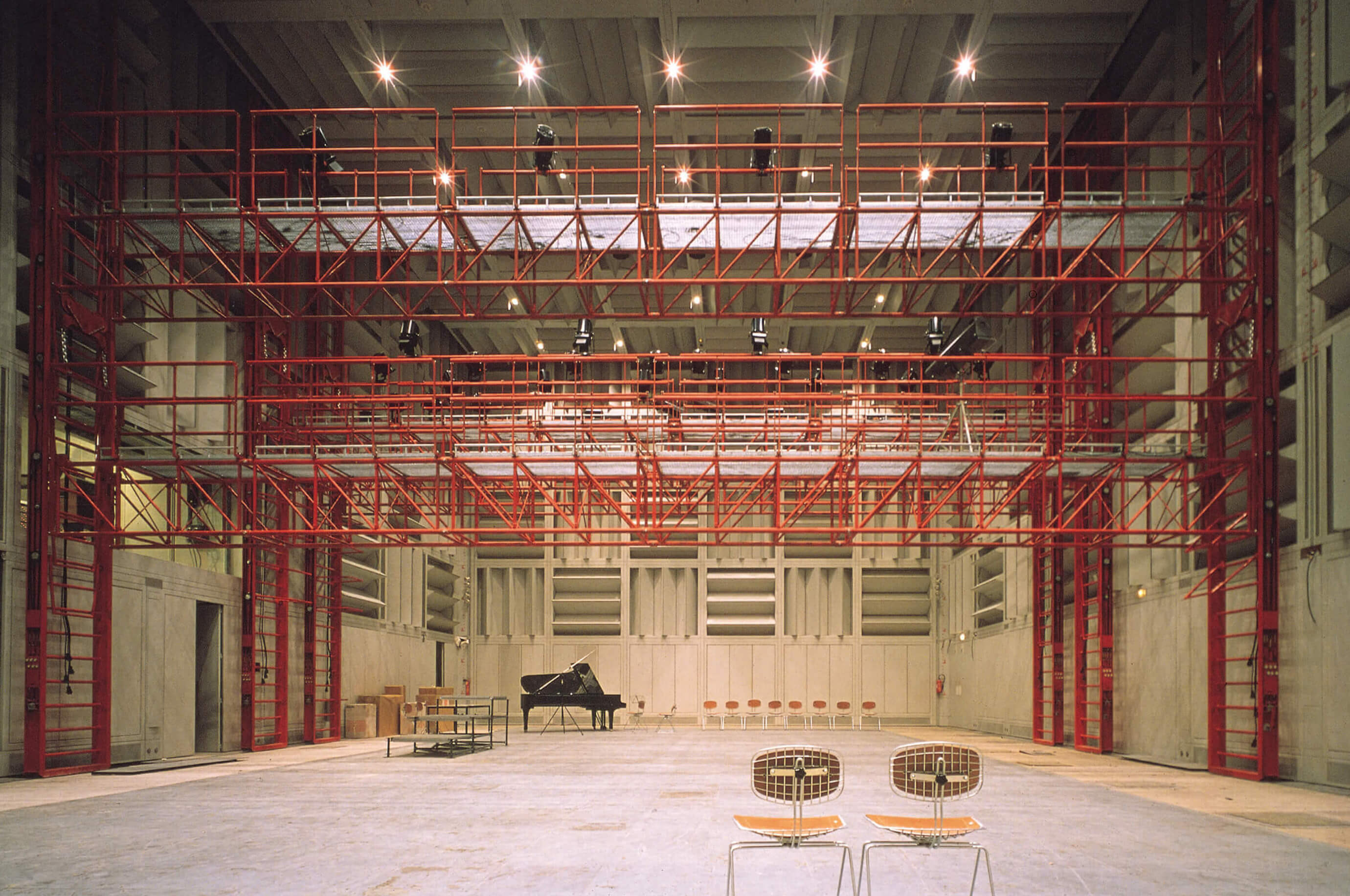 The Great Hall at IRCAM, where the acoustic can be adjusted from that of a cathedral to that of a cupboard
First up in Part 2: all the mysterious ways in which listeners back in the day heard avant-garde music, often without realizing it. Stay tuned for “Close Encounters with the Avant-garde”…
You can read Part 2 of this series here, Part 3 here, Part 4 here, and Part 5 here.